
Changing faces or multiple sites
Consider mobile crushing when the working face changes, equipment must serve more than one location, or reducing raw-rock haul distance is an important project requirement.
Quarry Buyer Guide · Configuration Comparison
Mobile plants suit changing sites. Stationary plants suit stable, long-term layouts. The quarry plan decides which direction is practical.
Quick Answer
Neither arrangement is automatically better. The practical choice is the one that matches the quarry plan and material flow.
Consider mobile crushing when the working face changes, equipment must serve more than one location, or reducing raw-rock haul distance is an important project requirement.
Consider stationary crushing when the quarry has a stable long-term layout with permanent feeding, conveying, screening and stockpile arrangements.
Both directions can be configured for substantial production. Material, feed size, final products, site limits and operating plan must be checked together.
These are selection directions, not absolute rules. A final recommendation requires the actual quarry data, transport conditions and required equipment scope.
Six Buyer Questions
The answers show whether mobility creates real operating value or whether a permanent plant is the clearer direction.
Clarify whether relocation is within one quarry, between working faces, or between separate project sites.
Compare the working-face distance with the planned crusher location and the available loading and haul equipment.
A temporary contract, phased quarry and permanent production base do not have the same layout priorities.
Mobile does not automatically mean low capacity. The complete feeder, crusher, screen and conveyor configuration controls the duty.
Check available space, foundations, hoppers, power, conveyors, drainage, stockpiles and local construction conditions.
Consider access, utilities, maintenance planning, wear parts, transport equipment and the experience of the site team.
Side-by-Side Comparison
The table gives a discussion framework. It does not replace a site-specific crushing plan.
| Decision factor | Mobile crushing plant | Stationary crushing plant |
|---|---|---|
| Relocation | Better suited to changing working faces, phased work or multiple sites when the transport plan is confirmed. | Better suited to a fixed long-term production location. |
| Raw-rock haul | Can be positioned closer to the working face where site conditions allow. | Normally receives material at a permanent crusher location. |
| Project duration | Often considered for temporary, contractor or staged projects. | Often considered for stable, long-life quarry operations. |
| Site preparation | May reduce some permanent civil works, but still needs safe ground, access, utilities and operating space. | Supports permanent hoppers, foundations, conveyors, screens and stockpiles. |
| Capacity | Can be configured for high capacity depending on the crusher, feeder, screen, circuit and material. | Can be configured for high capacity depending on the complete process and equipment selection. |
| Plant integration | Prioritizes transportability and modular site arrangement. | Offers more freedom for a deeply integrated permanent material-flow layout. |
| Transport between sites | Requires confirmed transport dimensions, route limits and suitable transport vehicles. Tracks are mainly for on-site movement. | Relocation normally requires dismantling and a new installation plan. |
| Maintenance planning | Access, onboard systems and mobile-module interfaces must be reviewed. | Permanent service access and workshop support can be designed into the site layout. |
If the quarry will operate for many years at one location, needs permanent stockpiles and long conveyors, or requires a highly integrated process, mobility may add complexity without solving a real operating problem.
If the working face changes, raw-rock haul is a major concern, the contract is temporary, or the equipment must serve several sites, a fixed plant may create unnecessary relocation and civil-work constraints.
Three Configuration Directions
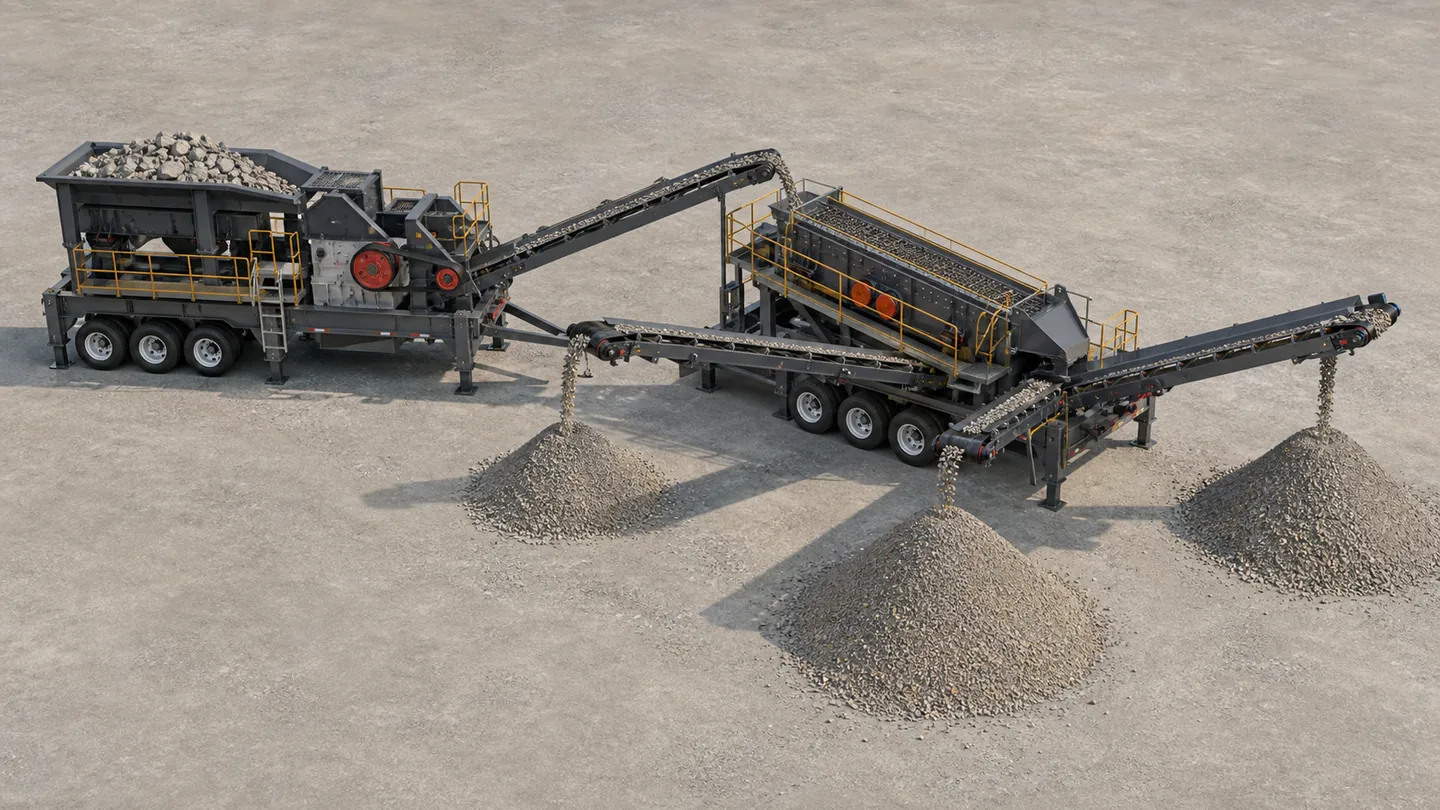
Zhongji manufactures tracked and wheeled mobile crushing plants and supplies stationary crushing equipment. Specific models and duties require confirmed technical data. For mobile projects, compare tracked vs wheeled configurations.
Tracked equipment is useful for movement around the work area. Moving it between distant sites normally requires suitable transport vehicles and route planning.
Wheeled configurations can suit relocation between sites, subject to road rules, trailer or towing arrangements, machine configuration and transport limits.
A stationary plant suits a confirmed long-term location where feeding, crushing, screening, conveying and stockpiling can be planned as one permanent system.
Related Pages