
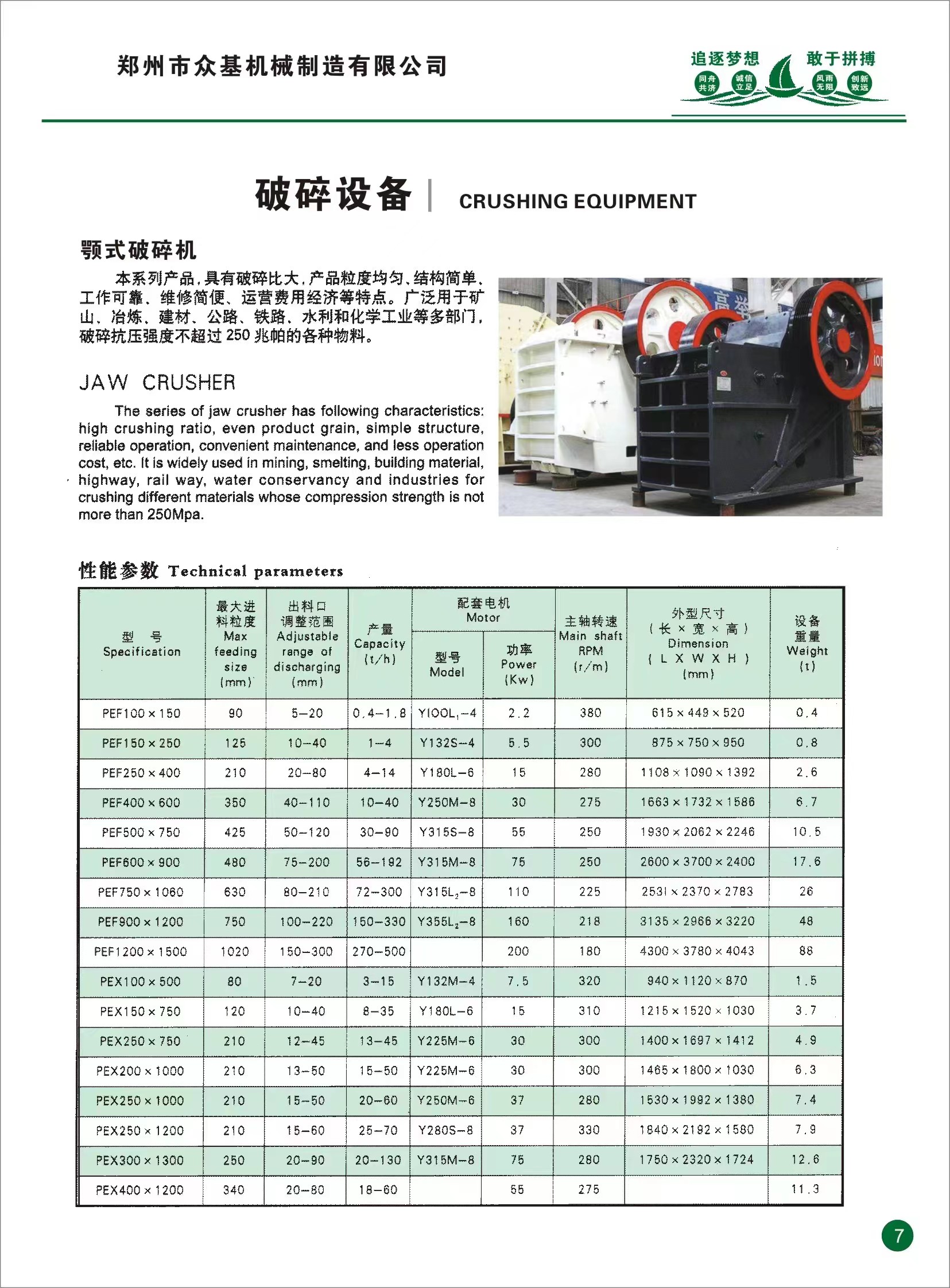
Equipment Workshop
Real workshop footage showing equipment handling and production activity.
Primary Crushing Equipment
Primary crushing for quarry stone and ore. Compare feed opening, discharge setting, capacity and motor power.
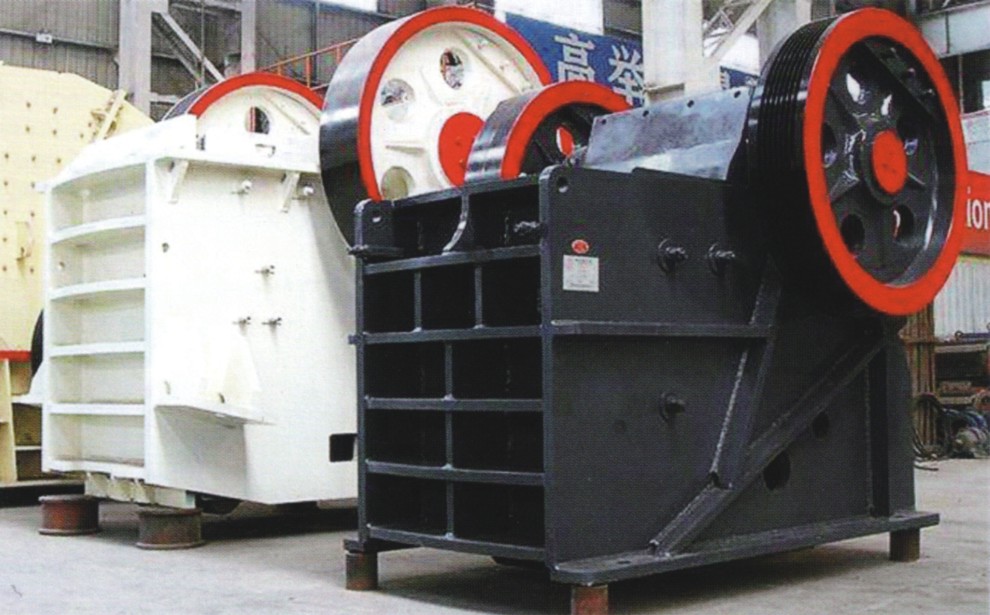
Technical Specifications
Capacity figures are reference ranges, not a guaranteed result for every material. Actual output depends on material, feed grading, discharge setting, feeding continuity and operation.
On smaller screens, scroll the table horizontally to see overall dimensions and weight.
| Model | Feed and discharge reference | Capacity and motor reference | Overall dimensions (L × W × H) / weight |
|---|---|---|---|
| PEF250 × 400 | Maximum feed: 210 mm Discharge range: 20-80 mm | Capacity: 4-14 t/h Motor power: 15 kW | 1108 × 1090 × 1392 mm Weight: 2.6 t |
| PEF400 × 600 | Maximum feed: 350 mm Discharge range: 40-110 mm | Capacity: 10-40 t/h Motor power: 30 kW | 1663 × 1732 × 1586 mm Weight: 6.7 t |
| PEF500 × 750 | Maximum feed: 425 mm Discharge range: 50-120 mm | Capacity: 30-90 t/h Motor power: 55 kW | 1930 × 2062 × 2246 mm Weight: 10.5 t |
| PEF600 × 900 | Maximum feed: 480 mm Discharge range: 75-200 mm | Capacity: 56-192 t/h Motor power: 75 kW | 2600 × 3700 × 2400 mm Weight: 17.6 t |
| PEF750 × 1060 | Maximum feed: 630 mm Discharge range: 80-210 mm | Capacity: 72-300 t/h Motor power: 110 kW | 2531 × 2370 × 2783 mm Weight: 26 t |
Dimensions above are the catalog's overall machine dimensions, not installation, foundation or shipping dimensions. For foundation design, lifting or transport, request the drawing and weight confirmation for the quoted configuration.
Source: Zhongji Jaw Crusher technical sheet, printed page 7 (PDF page 4). The catalog revision date is not stated. Confirm current configuration and supply scope before quotation.
Comparing lower-throughput equipment? See the small jaw crusher model comparison.
Product Introduction
A jaw crusher uses a fixed jaw and a moving jaw to compress large feed into a smaller size. It is normally installed after controlled feeding and before secondary crushing, screening or grinding.
Common applications include quarry stone, granite, basalt, limestone and ore preparation. The required opening and model depend on the real feed size and output duty.
Main Features
The moving jaw compresses material against the fixed jaw for primary size reduction.
The documented model range covers different feed openings for quarry and mining applications.
The discharge opening is selected within the documented range for the required downstream size.
Jaw plates and the chamber can be inspected as part of routine wear management.
The machine can work with feeders, conveyors, secondary crushers and screens.
Real Photos / Videos
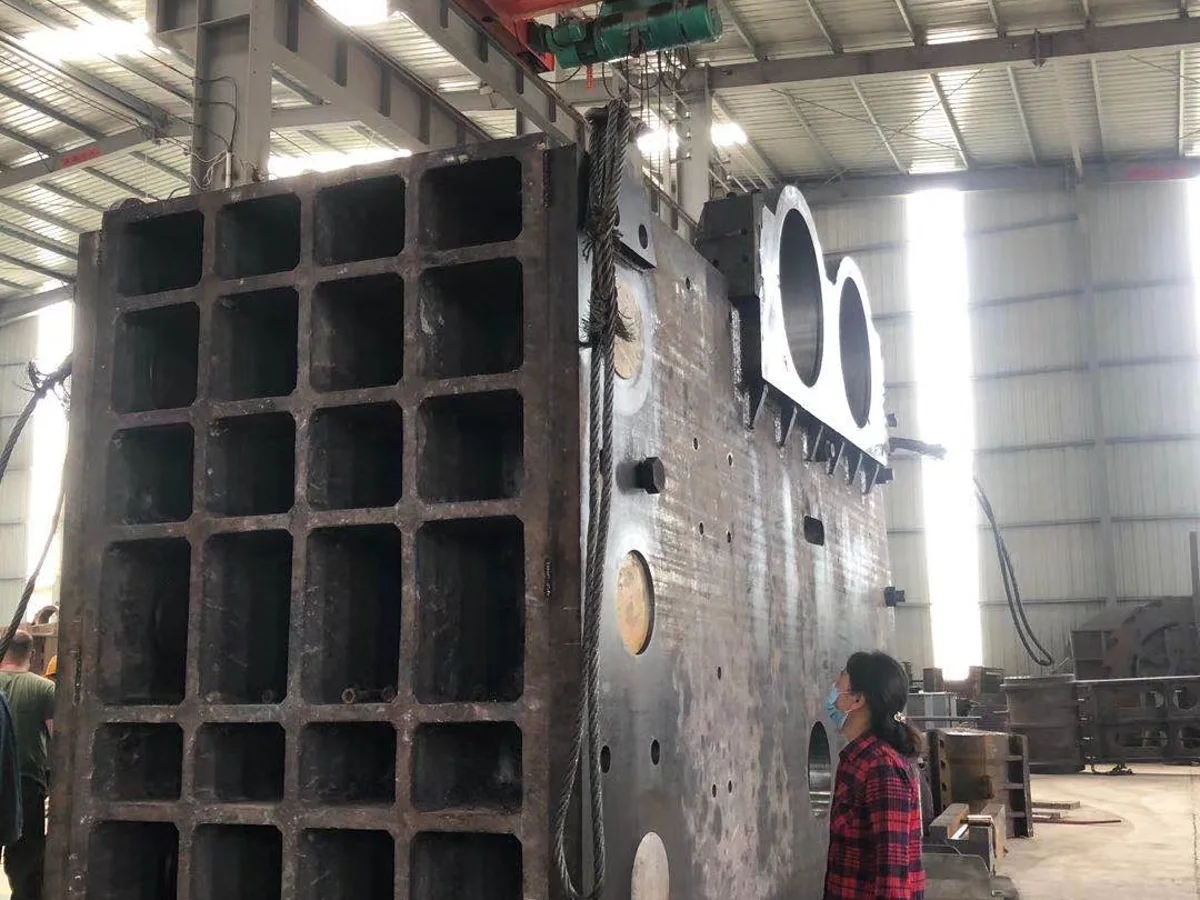
Real workshop footage showing equipment handling and production activity.
Real equipment workshop footage; it does not verify an operating jaw-crusher project.
Working Principle
A motor drives the eccentric shaft so the movable jaw approaches and moves away from the fixed jaw. Material is compressed in the chamber and leaves through the lower opening after it becomes small enough.
Technical Downloads
Only the existing Zhongji technical sheet is offered here. Final model selection still requires the actual material, feed size, output size, capacity and site conditions.
Product description and model parameters from the existing company documentation.
Download Technical SheetMaintenance and Installation
The checklist below is a planning framework. Exact intervals and procedures must follow the supplied manual, site safety rules, material abrasiveness and inspection findings.
Safety: Stop and isolate the power before clearing blockage, adjusting or replacing parts. Installation, lifting and electrical work require qualified personnel and the confirmed machine drawing.
Confirm foundation or support dimensions, anchor positions, maintenance clearance, feed arrangement and discharge connection before the machine arrives.
Confirm the actual machine model, jaw-plate profile, part markings, photos and dimensions before ordering jaw plates, toggle parts, belts or related components. Planning your first spare-parts order? See the jaw crusher spare-parts checklist.
Check alignment, fasteners, guards and rotation direction, then complete the no-load and controlled-load checks required by the supplied instructions.
Common Operating Problems
These are general checking directions. Stop safely and contact qualified technical personnel when the cause is uncertain.
Buyer FAQ
Jaw crushers are commonly used for quarry stone, granite, basalt, limestone, river stone, gold ore, copper ore and other hard or medium-hard materials. Final suitability should be checked by real material condition.
Common users include quarry operators, mining users, aggregate plants, contractors, EPC companies and local equipment dealers.
A jaw crusher is typically placed after a feeder and before a vibrating screen, secondary crusher or grinding equipment.
Choosing a jaw crusher for a quarry? Check feed opening, capacity and discharge duty → For output planning, read the jaw crusher capacity guide. For machine quotation factors, see the jaw crusher price guide.
Contact
Tell us the material, maximum feed size, required capacity and final size if available. We will start with the machine duty.
Send Your Requirements